Thursday, October 30, 2008

The People of Botswana: Batswana

It would be more than a little presumptuous of me to pretend that in the short 95 days that I have been residing in Botswana, that I have any idea of the values, beliefs, and culture of my adoptive people (that may be a little extreme but it sounds nice.) Therefore, this won’t be an exhaustive investigation of that topic, instead it will be an assorted list of particularities that I have discovered and found to be noteworthy during my time here
Respect For Nature
One of the first things I was interested in when I got here was how individuals felt about wildlife in Botswana. I knew before coming that tourism is a major industry here and that tourism is nature based. I also knew that there was significant environmental protections in place making Botswana an example of wildlife preservation in the region. However, just because the government behaves one way doesn’t mean that the regular Motswana feels the same way. As such, shortly after getting here I began asking people about the topic. What I learned was interesting, but not all together surprising.
Among educated people there is a consensus that protecting wildlife is important and that the current protections in place are a good thing. I think this comes from the fact that generally the people I talk to understand the value of the tourism industry and the fact that the environmental protection has very little real effect on most people’s daily lives as the protected areas tend to be in remote places little needed by humans anyways. Despite this sentiment though, it seems as though the environment and wildlife are simply not on the front of anyone’s mind, it as if when you ask them about it you’ve startled them and they have to search for a response. This too is not totally surprising as, like I said before, it simply doesn’t affect most people on a daily basis.
Alcohol
Another interesting, noteworthy, yet not totally surprising part of life here is alcohol. Batswana LOVE it. I have quickly found that in general people here drink significantly more than I have seen in the U.S. There is an on-campus bar that is buzzing 7 days a week and empty bottles can always be found all over the ground. This, in my opinion, is encouraged by one overwhelming thing, there is simply nothing else to do. Having come from a twenty four hour society that constantly bombards us with things that must, or can, be done it is obvious that the pace here is slower. There are fewer places to go and less options for entertainment, though some do exist. In addition, there are simply less hours in the day, that is to say that establishments close around five to seven pm and usually don’t open on Saturdays or Sundays. Therefore, one past time is highly favored: drinking. Drinking is no doubt a past time here, when you ask a motswana what they plan to do on the weekend “Drink,” is not an uncommon response, as if to say “what else could there possibly be?” To go hand in hand with that, I found that there is no culturally accepted time to start drinking in the morning. I found this funny as there are many jokes in the U.S. about “Beer 30” or “Half past Beer O’clock” that simply have no place here. It is perfectly acceptable to drink from sun up to sun down.
Alcoholism is a problem here that is beginning to draw major attention. It doesn’t have the same notoriety as it does in say America but it is at least understood and action is beginning to counter it. Serestse Khama Iam Khama, the current president, has a large part to play in this. His father, the first president of Botswana Serestes Khama, died of pancreatic cancer that I Botswana is widely blamed on alcohol. Ian Khama recently tried to levy a 70% tax on all alcohol in Botswana in order to cut consumption by Batswana with the threat that is consumption didn’t fall the tax would increase to 100%. The law, while initially passing, failed to be enforced due to nearly universal opposition, a rarity in Botswana.
Cattle Post
The cattle post, what to say about it. The cattle post is, to me, one of the most interesting, yet silent parts of the Botswana culture. The cattle post is, in its purpose, a place near where one keeps there cattle, as often times a person lives in Gaborone but has cattle out in the country somewhere. It is important to note that nearly every person I have meant here owns some cattle, that is as much a part of their culture as anything else I may mention. However, to suggest that the cattle post is a utilitarian place is not accurate at all. In fact, as far as I can tell, the cattle post is more a place of rest and relaxation enjoyed mainly by men. I have never heard of a women going to the cattle post. It seems to me that while at the cattle post men simply sit around with other men, drink and have bon fires. Its almost as if the cattle post plays the role occupied by the “cottage” in my culture, but the cattle post is devoid of the family aspect. It is almost as if, if I may infer so much, the cattle post presents an opportunity for modern men to escape the confines of modern, quasi-western, society and return to their hunter-gatherer/herder roots. Where men could be men and not worry about any thing else, very “Fight Club” if I do say so myself.
Small Houses
The next point, that of “small houses” is more closely intertwined with cultural norms and values, and as such, I should tread lightly to avoid making overly general statements that could be construed as racist or insensitive.
Most of what I will say here I have learned in the random ramblings of my Social Problems in Southern Africa lecturer.
The small house in Botswana language and culture refers not to a house, but rather a person. A small house is a married man’s second woman. The whole concept is based on a very deep rooted paternalistic culture that reaches back centuries and has reinvented itself into the modern system. That modern system in fact encourages this practice due to its structure, in Botswana, as a life led in many places at once. This is a complex subject but, to attempt to simplify it I will say that most Batswana have many places that they can call home, they generally have a home in a city near where they work, a home in the village where they come from because ‘no one comes from a city’, and they generally have a cattle post. A man’s family lives in only one of these places, leaving him open to live a life without a family much of the time. This has led to the deeper entrenching of the “small house culture.” But, this was not invented recently, rather the whole idea is ancient and not unique to Botswana or Africa. Men in many cultures were allowed to have many women to satisfy their needs. Instead, it is the combination of the modern multi-house lifestyle combined with the culture of acceptance that sustain the practice. There is a phrase in setswana that loosely translated means “a man is like a bull and cannot be culled.” Meaning, simply that a one woman is not enough for a man. Another saying is “when you’re man leaves and comes home, do not ask him where he has been.” This time suggesting that a man is allowed to do as he wishes outside the home as long as he serves sufficiently as a provider for his family. While this has diminished slightly in recent years monogamy is still not as important in this culture as in my own. This culture of the ‘small house’ is thought to contributed significantly to the astronomically fast spread of HIV/AIDS in Botswana. As such, the culture is being attacked in recent attempts to stem the spread of HIV/AIDS.

(This billboard reads "People say that...Small houses strengthen relationships. But having small houses spreads HIV. Having more than one relationship over the same period of time highly increases your risk of HIV infection." This is an example of an attempt to fight the culture of the small house in an attempt to fight against HIV/AIDS)
How the culture of the small house and the popular religion of Christianity coexist I still do not understand.
Lacoa
Lacoa is a setswana word that means white person. Simple enough. However, it is not (otherwise I wouldn’t be writing about it). The interesting thing about this word is its double meaning. In addition to its primary use meaning white person, lacoa also refers to a good or generous person. This has very significant anthropological and sociological undertones. Whether the relationship was invented before the word came into use, or vice versa the result is a perpetual reinforcement of the superiority of white’s within Tswana culture. The ultimate result is that white people are associated with generosity and desirable qualities. The big picture on such an association is immeasurable as, despite Botswana’s seeming obsession with western culture it cannot be said that this is due, in whole, to the connection to white people, but it must have some affect. I truly have nothing to add to any effect here in terms of judgment, instead I offer it only as interesting.

If any one has questions about any other topics I would love to hear them. After all, some day I may just ask myself the same questions, and I will regret not writing them here.
Love to all,
Tommy

Tuesday, October 28, 2008

Short Trip to Namibia

So this last weekend (10/24-10/28) a couple of us international students decided to forget school for a little while (we missed class Monday and Friday) and see Nambia. We had heard that this weekend was “Ocktoberfest” in Windhoek Namibia, so we decided it was as good a time as any to check out the country.
Namibia is a small South-Western African Country with a population only slightly larger than Botswana. Namibia was a German colony and as such they still have significant lingering German flair from the Culture of Beer brewing with companies such as Windhoek and Hansa, to the large number of German tourists who still visit the country, so many in fact that everything is written in English and German.
We decided to rent a car in Gaborone (a 2008 Corolla that was much nicer than we expected) and drive to Windhoek overnight Thursday to Friday and then on to a small sea-side village called Swakopmund on Saturday to stay until Monday morning and then return to UB by the morning of Tuesday the 28th.

(Our car at sunset at the border crossing)
Thursday after my class I packed my things and we were on the road by about 6:30. There were four of us, Matt (American from Florida), Graham (American from Texas), Matthew (a Frenchmen), and me. The route was incredibly straight forward. Drive to Robatse (a village about an hour from Gaborone) then get on the Trans-Kalahari Expressway and take that all the way to Windhoek in Namibia. A total distance of about 1200 Kilometers (about 750 miles, about 12 hours). We had been warned before we left by our over worried roommates that we should be careful when driving at night because of animals, COOL! We decided we could take shifts and that way make it a straight shot with no one getting too fatigued. The drive overall was incredibly boring. The Kalahari however was interesting. We traveled most of the way through the desert in a huge, violent electrical storm which was amazing to watch, because the flat terrain allowed for a full 360 degree visual for miles, not to mention the fact that a thunderstorm in the desert is very cool. Mostly the animals we saw were domesticated cows and donkeys, however, we also say Kudu, Oryx, Wild Dogs, some birds, and other difficult to identify animals.

(Matt, Me and Matthew at a gas station in Kang)
Upon arrival at the border post at about 4 am we discovered, much to our surprise and chagrin, that the border post was closed. Very surprising given that we had investigated this possibility and had been assured it would be open. With no other options at hand we decided to sleep until the border opened at 7am. Unfortunately I had been preparing for my shift of driving and had enough caffeine in me to stay awake until 7am, when I should have finished my shift. That meant that I got no sleep.

(Graham slept outside on the ground out the border crossing)
When the border opened we got through without incident and were on our way again. As we approached Windhoek it became apparent to us that our fuel supply was quickly dwindling and the Kalahari desert didn’t offer many options in terms of fueling station. This provided for about an hour of very nervous traveling. Fortunately, we made it in to the Windhoek airport on fumes and Budget rental car (our car service) refueled us and we were back on our way. We arrived in Windhoek about 3 hours behind schedule, but none worse off. I didn’t actually have to drive at all because of the timing of our forced three hour nap Graham took my shift and drove all the way into Windhoek.
Upon arriving in Windhoek we immediately began searching for Ocktoberfest. As we walked around city center asking everyone we saw and receiving all manner of random and unintelligible or incorrect answers we realized that there was no “Ocktoberfest”. Either we missed it or it hadn’t happened yet but either way it just wasn’t happening. We were a little depressed for a little while until we found this little Biergarten (proof that it is a German place).
(The four of us at the gourmet)
We had a few beers, and a nice lunch. I for one ate the “Absalom’s Grilled Game ‘Sosatie’” consisting of Kudu, Oryx, Ostrich and crocidile and for desert Namibian strawberries with home made ice cream. It was a wonderful meal and we all decided that we didn’t need Ocktoberfest, we had fun ourselves.

(My game Kebab)
(Namibian Strawberries)

After dinner we wandered around Windhoek for a while. Matthew asked if we would be willing to go to the mass at the local church. We all agreed despite my anxiety over what I was wearing (for this I got called “waspy”). It was interesting. We walked in during the rosary. As the service began (the whole thing was in English) the Priest introduced an Australian man who claimed to be a healer. As the Australian began preaching I found myself caught up in his enthusiasm. He used the first person as God and began by saying that humans are made in God’s image and as such our wonderful creations and then launched into a long string of “you’re beautiful,” “you’re special” kind of stuff. It was interesting until the priest suggested that people simply go to God with their concerns and sins and they were forgiven. Now this seems fine and well until you consider the fact that this was a catholic church, they don’t do that! It became obvious quickly that this wasn’t our scene and the two Catholics (Graham and Matthew) suggested we leave. Matt and I agreed and we simply walked out. We discussed for a while how funny it was that the man and actually preached against confession. After that we returned to our hostel to go to bed early as we were getting up very early the next day.

(The beautiful church in Windhoek)
The next day began at 4am. We each got up and showered and got ready to leave. As each person showered it became clear that something was wrong with the shower, it was not draining. By the time I took my shower (last) the whole bathroom was flooded and the water was running out the door, down the hall and out the front door. We quickly packed up and left. It was my turn to drive to Swakopmund so I did. It was strange driving on the left side of the road and things like the blinker and the shifter being on the wrong side of the car gave me fits but we made it Swakopmund safe and sound.

(Me on a dune)

(Matt just goofing off on the dunes)
We got to Swakopmund at about 8am on Saturday. This was a beautiful place. It is a seaside town with giant sand dunes on the other side. We didn’t have plans for Saturday so we just enjoyed the town. We drove out to a nearby recent shipwreck and explored the dunes a little. We decided that for Sunday we would split up into two teams. Matt and Graham wanted to go Shark fishing and Matthew and I would go sand boarding.

(Matt, Mathew, and Graham in front of a recent shipwreck)
For sand boarding we woke up at 9:30 and were chauffeured to the dunes. We were handed gear and began our hike to the top. We were divided into two groups, those who had snowboarded and those who hadn’t. At the same time there were “lay down” sand boarders (basically sand sledding) on another part of the hill. Matthew is a dedicated skier and as such was with the beginners and I was with the more advanced group. The beginners got normal snowboards exactly the same as any other snowboard, the more advanced group had the same except ours had Formica sheets taped to the bottom to help us glide better and before every run we had to wax the board to keep it from sticking. I was expecting the sand to be very hard to slide in but really the sand preformed just like a nice snow, not heavy like deep powder but very even and clean riding. It was awesome.

(Sand boarding came pretty natural to me)
After a few runs they gave us the opportunity to try lay down sand boarding on the fastest run of the day. On the radar gun they had they told me my top speed was 68 kph (about 42 miles per hour). That was really cool. After the sand boarding was over they gave us sandwiches and drinks (all we wanted) and we sat around and chatted. It was great fun. While we were sand boarding Matt and Graham were shark fishing. Well Graham was and Matt just watched him. Apparently, they had a great time.

(Graham's huge shark)
The following day all of us planned to go quad biking (a quad bike is an ATV) on the dunes. Again they picked us up and took us right to where we were going to ride.

(Our quad bikes)
(The four of us during our quad biking)
(Me and my quad bike)
We got two hours of riding. Riding on the quad bikes was an awesome way to experience the dunes. We drove around for two hours and, according to the guide, covered about 50 kilometers. We drove up and down the sides of dunes at high speeds. At a couple points we stopped at on a particular occasion it hit me just how surreal these dunes are. I couldn’t even believe their size, shape, and beauty in stark contrast to the ocean right across the highway. The guide told us that the iron mixed with the sand worked together with the winds to form and hold the shapes of the dunes. The whole experience was amazing.
After the quadbiking we packed up and hit the road back to Windhoek. We stayed there a short time while Graham was giving a presentation to the rotary club in Namibia and then we headed home. We arrived in Gaborone at about 8:30 in the morning on Tuesday, totally exhausted. It was so worth it.
It was a great trip!
That’s all for now,
Love,
Tommy

Tuesday, October 14, 2008

School and Classes in Botswana: At the Halfway Point

Well the title of this post may be just a tad misleading as I am actually just past the mid point but that isn’t terribly important. One of the most common questions I get from friends and family at home is “How are the classes?” I almost always give a different answer because it isn’t so easy to just pin down “how they are.” Each class is different and as the semester has progressed each class has taken on a life of its own.
Some of things they have in common include that 80% is an A. Justification for grades is a luxury generally with held and punctuality is very important for the students, and not at all for the lecturers.
Population Studies: Population Policy of Botswana.
If I had to choose one I would say this class is the most like a normal class at K but I would do so hesitantly. The Teacher, Mr. Dintwa, is very young and doesn’t control the class well it has never gotten out of control, but the organization and structure of the class simply leave something to be desired. He is never late if you take into account the fact that at the beginning of the course we decided that the class would always start ten minutes late. His lectures are at best, lacking. Generally he gets up in front of the class and reads his note word for word which the students in turn write down word for word. He almost always repeats himself 4 or 5 times on every sentence so everyone in the class can copy his words. This whole process gets very irritating for me, because I refuse to copy his words verbatim.
So far in the class we have had two assessments. One was a group project made up of a presentation and a paper. The other was the midterm exam. The group project was awful. It was me and a group of 4 other Motswana (I am the only international in the class). We met three times and every meeting went for 4-6 hours. We accomplished nearly nothing until finally I asked if I could type and finished the project with little to no consultation of my group mates. The fact of the matter is that Motswana are not educated in the same way as I was so the work they are trying to do is hard for them and easy for me and they seemingly don’t care to try. After the paper was submitted (after me single-handedly editing it) we received an 84%, much better than expected and much better than most any other group. The exam, though I had no idea what to expect, was in fact quite good. It was just a single essay question on a topic we had discussed in class. I got the exam back and I received an 86% again a grade I was pleased with but there were no comments on the paper except “Well done Mr. Turner.” I feel that if it was too good to warrant comments than perhaps I should have gotten a 100% but I am not prepared to fight about it, as long as I get good grades.
Archaeology of Botswana
This is the class I was most excited for but it hasn’t been everything I hoped. The teacher is fine other than the second week of the class when he tried to change the time of the class before being told by the registrar that it was unfair to change course times after schedules had been finalized. Most of the course has been made up of group presentation. The class was divided into 10 groups and each group was to present a chapter of the text book. The assignment was unclearly defined, all we knew was that we were supposed to review the chapter and present for about 45 minutes. After each group presents the teacher opens it up and allows the class to suggest what they should get. Most times the class recommends something between a 65 and 75% and usually the teacher awards between a 68 and 76. There is however no justification for these grades, or at least it would seem. He almost never tells the group how they could improve or what they failed to accomplish. My group was the first decent group (the two before us were terrible) and were awarded a 80%. My group members seemed thrilled with the grade but again I wondered why not better than 80% if he had nothing bad to say. I asked a friend what the deal was and he recommended I not go to the teacher and ask why I had gotten the grade I did, he said that’s just how it is, and I guess it doesn’t surprise me why would the teachers be accountable in this area. I have discovered that this teacher refuses to give really good grades although he has no reason to do so. The teacher has not lectured barely at all because of these presentations. The other assignment in the class was a paper about a piece of legislation called the “Monuments and relics act of 2001.” We were supposed to review it and suggest ways to improve it. After turning it one month into the year it was finally returned more than 7 weeks later. The teacher announced that there were only two A’s a 86% and an 80%, not good odds and I was nervous as this was my first archaeology class and I was surrounded by archaeology majors. As it turned out I received the highest grade in the class, which made me wonder why I was more capable than all of these fourth year archaeology students. Again no comments on the paper but I was too thrilled to care.
Sociology: Social Problems in Southern Africa.
This is without a doubt my strangest class and perhaps my most rewarding class. I say that because every lecture, without fail, is interrupted in the middle by a 25-30 minute discussion about social problems in Souther Africa. Generally these discussions turn into the teacher telling the class what’s wrong with their culture (He is one of them but he ignores that fact.) Teen pregnancy, Aids, Small Houses and adultery (two issues I’ll discuss at more length in a later post), Zimbabwe, Batswana being lazy, Rape, Crime, the South African political system, and many other things are among his favorite topics. These discussions are fascinating though because when the other students comment it gives me an idea of how they think and feel. For example, on one occasion the issue of marital rape, normal rape, and statutory rape came up. The Teacher asked “Is there such a thing as marital rape?” The general consensus among the class was that, “Once a woman is married her body is her husbands and if she denies him than he should go to a prostitute or get a divorce.” All of the western students (I am the only white male in the class but there are many “White People” in the class) voiced our opinion that a women’s body is always her own even after marriage. Then the teacher said, “Can a women rape a man?” This time was that “A man can’t say no, men always want sex so he can’t be raped.” I didn’t even notice that I was shaking my head so violently but the teacher asked me what I thought and I stated that there were concepts such as statutory rape and that men have the same capability to say no as a women and could be raped just the same. All the European and American girls in the class later came up to me and congratulated me on having the courage to say that out loud, but I could not keep quite but the whole experience was great for learning about the values of Batswana and learning that those values are not homogenous.
When it came time to have an exam in this class a friend warned me that, “Mr. Ntau’s tests are impossible. Make sure you know the names, titles, and dates of all the books he talks about.” That comment made me very nervous after all I have never considered that the most important part of a class. When I saw the test I realized she had been right and I realized that common sense could have gotten me a 75% on the first day of class. Most of the questions were more a matter of deciphering than knowing what the right answer was. The whole test took me 8 minutes and I was thrilled to have it over with.
Economics of Southern Africa and Botswana
Since I am giving each class a distinction this class would have to be my most disappointing so far. I was really excited to study about the economics of Botswana since Economics is a subject I love. The class is team taught by two teachers, one the first half the other the second half and the second teacher has just begun teaching so my thoughts here are only on the first teacher.
This class has been the really strange. For about a week in the class we went over a slide show that was about 15 slides at a pace of about 2 slides per day. The teacher would put up the slide and tell us what it said, all the while telling us not to write and just to listen, but everyone wrote anyways. Then he would ask if we were with him every couple seconds. After he finished reading the slide he would give us 5-10 minutes to copy down the slide all the while telling us that the power point was online so we shouldn’t copy it down. We copied it anyway. Then he would recap the slide before moving to the next one. None of these lectures were more than 20 minutes in length. After that week class was cancelled at least once a week usually twice and when we did have class generally the teacher would give us a hand out, read every word of it aloud and then let us go after about 10 minutes. Finally by the 6th week of the semester the teacher said he was done teaching and that class would resume after the short break, I was a little upset because I felt I hadn’t even learned anything.
During this time we had one assignment. A paper between 3 and 5 pages about one of the topics on the slide show, economic development theories. This was the first paper I had submitted at UB and I just assumed that the guidelines were similar ot at K but I didn’t know for sure and did make some mistakes, for example, I learned after I turned it in that everything here needs a cover page. Honestly, the paper I submitted was sub-par and I had no idea how it would be scored. I received a 15.5/20 which in my opinion may have been generous but again there were almost no comments on the whole paper except that it was missing a conclusion, something, had there been a clear assignment, that I would have not forgotten.
Setswana
Setswana is the only class that is everything I expected it to be. It is just like a normal language class anywhere. I enjoy it but I wish it was a one hour class instead of two. I feel I am learning but not fast enough and I never really speak in Setswana and after I leave, I know I never will again which is disappointing. For the mid-term in Setswana I studied very hard and it was just as I expected. I got a 94% (second highest in the class). I was very pleased but as always language is very hard for me and I am only learning very slowly but the teacher is wonderful and I am enjoying it.

To sum it all up, I told someone the other day, the classes are challenging but the expectations are so low that really, school is quite easy. Overall, my classes get in the way of me having more fun but I am learning about Botswana and I can’t say they are worthless, I don’t believe they are. I think I am doing well overall and as along as I keep it up I can allow myself to have fun and still succeed in school.
That’s all for now,
Love to all,
Tommy

Saturday, October 11, 2008

Football at the national Stadium

Today was quite the event! Botswana and Mozambique were scheduled to meet in the first round of qualifying for Southern Africa. Going into the game it was already nearly decided that Botswana was unlikely to move on. In fact, I heard that in order to advance Botswana would need approximately a seven goal differential to advance, in addition to a lot of help from some other teams. In addition, it is no secret that Botswana is simply not very good at football (remember football here refers to soccer, they use both words here which is very confusing to me).
Nonetheless us international students were SO excited to go and see the game!

(Some international students dancing with some Batswana at the game)
At about 11am I walked over to the Botswana Football Association (BFA) administration building and bought one ticket in the "Panda," for 30 Pula ($5). At least I think it was called the Panda, on the ticket it said "East Stands" but my roommates said it was called the Panda. Apparently the Panda is were the roudiest of the roudy sit (a huge overstatement), AWESOME! Across the way in the West stands (50 Pula) was where the calm fans sat under shade.
With the prior knowledge that the stadium was dry (turned out this was kind of an understatment as barely any concessions were available) some of the other international students decided to "pre-game a little" I did not partake.
At about 3:30 we decided it was about time to head over to the stadium. The National Stadium is located about a ten minute walk from our dorms and about 30 feet from the North gate to campus. Upon arriving we had no idea where to go.

(The interior of the Stadium with Gaborone in the Background)
Eventually, under the leadership of Matt, we simply flung ourselves at a gate and hoped they let us in. As we handed the ticket taker our tickets they informed us that this wasn't the right place but Matt got the impression we could get through to where we wanted to be from there. Turns out we couldn't. Unfortuately we hadn't been left with a ticket stub to prove we weren't where we had intended to be. In fact, the reason we had been admitted was because we were in the only seats in the stadium less exspensive than the East Stands. Finally we convinced a police officer to aid us in getting to where we had wanted to be.
As the game began, around 4:30, it had many of the ceremonial trappings of any professional sporting event, including a police marching band (that looked to be fashioned after the british, big surprise there *rolls eyes*).
I had not approached the game with overly high expectations in terms of the quality of the game which turned out to be a very good thing. About ten minutes in the Zebras (Botswana's team) allowed a sloppy goal in and that was all it took. The rest of the game was honestly rather mundane but no less sloppy.

(Matt and Mathew look on)
The pinnacle of said sloppiness being when the Zebra's keeper attempted to boot a ball down field but abruptly had the ball stolen right from his foot. He launched, immediately, into full on defense mode chasing the Mozambique player all the way to the sideline. It was absolutely remarkable that there was not a score as a result.
What is more of note is that as we were sitting on the East side of the stadium we were staring into the sun all afternoon, and it was a rather warm afternoon (89 degrees but I swear it felt warmer than that).

(Me with the Stadium in the background)

Overall, I am pleased with the experience. It was fun to watch some sports and neat experience to visit the national stadium.

That's all for now,
Love,
Tommy

Wednesday, October 8, 2008

Pula Thebe

The title of this post means "Rain" (Pula) "Drop" (Thebe). It is quite appropriate given the fact that last night was the first rain. That is to say it was the first rain during my stay in Botswana and in fact, quite a lot sooner than expected.
At about 9:30pm I thought I heard thunder but on other occasions I had heard similar noises that turned out to be large trucks or something else but this time there were no trucks in site. Then I saw lighting. Perhaps heat lighting I thought, but I went out to see anyways. As I got outside I was surprised to feel big wet drops falling on my head and about ten other international students standing outside staring at the sky. It was rain indeed. In about 10 minutes the rain had all but stopped but we stood outside a bit longer enjoying the moment. In about an hour all the puddles had disappeared and the event was over.
Not terribly exciting, but the fact that it is of note, is perhaps of note.


(This photo actually taken on October 17th in a similar event)

Saturday, October 4, 2008

My Incredible Journey

I always like to rationalize the title in the first sentence of the post, in this case it will be the second sentence. I have entitled this a journey because indeed, point A and B and C were only minor breaks placed to fill the gaps between the transportation. Unfortunately there won't be too many pictures in this blog and any that are here are from google (ugh), I will get to why later in in the post.

(A simplified map of Southern Africa to make it easier to follow along)
Saturday
On the last day before the trip I was pretty sure of how I wanted things to go. I had purchased 3 bus tickets including the first two of the journey and I had been in contact with the first hotel I planned to stay in. I was nervous, but also excited. I wanted to go to bed early as I had to get up around 5am to get to the first bus stop on time. I had talked to my roommates about the exact location of the bus stop and had realized there was no way I could walk there, taxi it was then. Right before going to bed I discovered that one of my water packs was leaking profusely and had soaked through my bed. What a horrible omen for the rest of the trip. I was furious but dealt with the issue and refilled the water pack.

Sunday
I got up right on time grabbed a quick shower and called a taxi. Not open (CRAP!). I started to panic (this will become a theme). I just decided to start walking and see what I could do. I worried the whole time that I wouldn't make it to the stop. I did catch a taxi and was to the bus exactly 30 minutes before its intended departure time. Got on no problems and was off. The border crossing was no trouble and before I knew it I was underway into South Africa. I arrived in Johannesburg (from now on Jo'berg because NO ONE calls it Johannesburg). I was thrilled to find that I could purchase Greyhound tickets here. I thought I was going to have to find where to buy them in Bloemfontein but that was not the case. I sat around and waited for a couple hours. During this time I learned that in Botswana when they see you're white they assume you speak english and speak english to you. In South Africa when they see you're white they assume you speak Afrikaans, which had me asking people to speak english all day. Apparently Park Station is the largest bus station in Africa south of the Sahara.


(Park Station in Jo'berg)
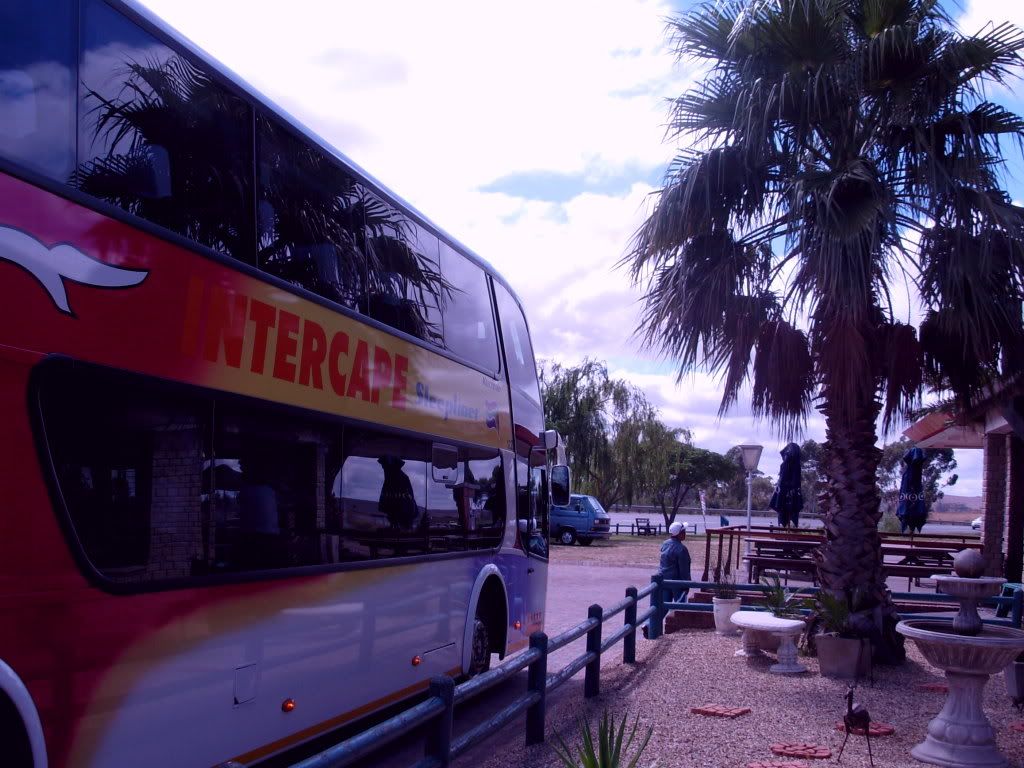
Then I was off onto my next bus. The bus from Jo'berg was potentially the nicest bus I had ever ridden. It was called a sleepliner and the seats could recline 150 degrees and there was plenty of leg room.

(Intercape Sleepliner)
Somewhere in transit I noticed the ground at my feet was soaking wet. It took me only seconds to realize the water was leaking from my water pack onto the floor. The wind blew completely out of my sails. Fortunately I had no one beside me so I managed to contain the water until I got off the bus. I had expected to arrive in Bloemfontein after midnight, but apparently I had misinterpreted the ticket and we actually arrived at about 9:30. I had been worried the whole bus ride (on the verge of panic) that I wouldn't be able to find a way to get to Maseru (Mah-Say-Ru). Afterall none of the major commercial bus companies travel to Lesotho. Upon arrival in Bloemfontein I went to each of the bus ticket windows and each sent me to the next until I finally discovered it was hopeless. I took a very deep breath and decided nothing could be accomplished and that the best course of action was to find lodging and come back on Monday morning. My original intent had been to arrive in Bloemfontein on Monday morning for this very reason. I looked through the big book of hotels the station had and picked one out. Hotel Mamello. I arrived checked in and began spreading out my soaked clothing and my book (having finished my first book I really wanted to dry my book so I could read it!) The hotel was only 240 Rand (about $30) and you could tell. The room was tolerable but not much more. No shower only a bath. But I didn't mind I only needed to sleep for the night. I laid down very early and decided all I wanted to do was sleep, unfortunately I had consumed 2 litres of Coke Zero so sleep didn't really happen.

Monday
I woke up with the sun and was ready to go. I ate the breakfast provided at the Hotel and then walked the four blocks or so to the Tourist center/Bus station to try again to find a way to Maseru. I walked into the tourist office as a tall man with a large back pack walked out. I asked the woman at the desk how was the best way to get to Maseru and she told me the man who had just walked out was going there and I could follow him. I introduced myself to the Man and told him what I wanted to do and he was more than happy for me to tag along until we got to Maseru. His name was Danny and he was originally from Namibia (a white guy from Namibia) It turned out he was a missionary (not a professional, just a volunteer) headed into a very remote part of Lesotho that would take 7 hours by bus and 8 days by Pony to get to. I followed Danny to the Taxi rank in Bloemfontein. He showed me the office and helped me find the taxi that would take us to Maseru.

(The Taxi Rank in Bloemfontein)
(Posters like these were all over in SA)
It was actually a minibus that proudly proclaimed it was certified to carry 15 passenger but to me it looked more like 10 people would fit, nonetheless there were 15 in it when we left. We sat in the mini bus from 9am until 11:30 just waiting for the bus to fill so we could leave. The whole trip I was flipping out about what might happen if at the border I couldn't get through without a Visa that I did not have. I knew there was little to nothing I could do but I was still panicing. We arrived after a two hour drive through terrain that looked a lot like the trip from Reno into Lake Tahoe (minus the Lake of Course). We arrived in Maseru and much to my surprise I got through no problems at all. I took a quick breath with that very nerve racking part of my trip done I thanked Danny said goodbye and good luck. I grabbed a taxi and asked for the Tourist center. The guy charged me R50 (the Taxi from Bloemfontein was only R70) and didn't even take me to the right place, this is when I began to start being bitter towards taxis in general. I walked to the right place. This is also when i learned that the Malotti and the Rand are equivalent and as tourist there is no reason to have Malottis. I must say it wasn't too hard to find because it has a very unique shape. It is in the form of the trademark hat of the Basotho people. I got some info about the country as well as how to get to the Taxi rank that could help me get to Malealea (Mah-Lay-A-Lay-A).

(The unique Tourist Center in Maseru)
They gave me a map of Maseru and pointed me in the right direction. I stumbled around Maseru for about two hours trying to find the Taxi Rank I had been sent to. I walked just about everywhere but the right direction until I finally found. I finally found the Taxi ranks and began stumbling around in the Taxi. I must admit, of the whole trip, this was the most threatening place I found myself. I had gotten used to seeing a handful of white people where ever I went but this place had none, the Basotho (the people of Lesotho) noticed too. As such I got cat called and people yelled at me in Sesotho (the language of Lesotho) and when I failed to respond they got angry and shot me dirty looks. This is when I learned that English is not as well known in Lesotho as it is in Botswana and South Africa. The language of Setsotho is closely related to Setswana so on occasion I used the tiny bit of Setswana I know to bridge the gap between English and Setsotho. Especially "Ke bo kae?" meaning "How much?" I finally found the mini bus I was looking for after a kind police man helped me out by guiding me through the hundreds of taxis (mini busses). I got on and we were off shortly. (More proof that that taxi was a rip off, this trip cost R30.) One of the best things about these mini bus rides was meeting new and interesting people. On this trip I met two men who were very kind and for the whole two hour trip we chatted about the country. I learned a lot from these men about the history of lesotho. One of them was a teacher and the other a young man. I learned both of their names but have since forgotten them unfortunately. The trip went fast despite being very cramped and finally I arrived at my first "intended destination." Malealea Lodge and Pony Trek Center.

(The lodge I stayed in)
Malealea Lodge is actually comprised of many small and medium sized huts and buildings. I rented one the guy at the desk referred to as the "Honeymoon Suite." I still don't know how I felt about that. The lodge is beautiful and rustic, meaning it only has electricity between 5pm-10pm. Upon arriving I also received a list of activities available at the lodge. The list included pony trek and 4x4 Excursions. I had really hoped to do a Pony Trek but realized that they needed at least two people. For the first time on the trip I felt profoundly lonely. I can't remember feeling that alone for quite some time. For most of the day I had been worried about how I would get back to Jo'berg by 8pm on Wednesday. This was one of the connections that I had least anticipated. I decided that while this lodge was amazingly beautiful I was going to leave the next day and return to Bloemfontein Tuesday night to catch the bus from there to Jo'berg Wednesday morning. It was disappointing to me that I wouldn't get to do the fun activities at the lodge but I got over it and resolved that one day I would return to this place. After the long day on very little sleep I just went to bed early.

Tuesday
I woke up with the sun again and went and got the traditional English breakfast provided at the Lodge. I informed that I would like to check out around noon, they were fine with that. I spent the rest of the morning reading looking over the AMAZING scenery of the place and taking a short hike around the lodge. During my hike a young man approached me and introduced himself as Joseph. He guided me around the village of Malealea and pointed out some points of interest. He told me he was 15 and both of his parents had died. When I asked him if he went to school he said he didn't because he couldn't afford shoes and sure enough he was barefoot. I realized that Joseph was a tour guide for the lodge for a living and he was giving me a tour. If he hadn't told me his story I might not have thought to pay him but I did (perhaps that was what he was going for but the company was worth it to me.)


(Malealea Village)
At about Noon I checked out and boarded the bus back to Maseru. This time I didn't get lost and didn't hire a taxi. I choose instead to find my way across Maseru to the border. I made the trek and learned it was quite a lot longer than I had expected but it gave me a wonderful opportunity to see Maseru and the surronding mountains after all I was in no great hurry. The walk was about 10km (6 miles) by my guess but it was nice to stretch my legs. I boarded the second taxi and returned to Bloemfontein. I arrived at about 8pm and walked to the tourist center (about a mile) by myself in the dark, purchased an Intercape ticket to Jo'berg the next day at 3:00 am (WHA!?!?!). I wasn't quite sure what I should do. I decided I would go back to Hotel Mamello and try to get some sleep. I walked to the Hotel (only about four blocks, remember how I was bitter with Taxis?) I never even came close to getting lost despite only having been to this city once before, I think my sense of direction may be improving. I grabbed a room and was asleep much faster this time. I set my alarm for 2:00am the next day.

Wednesday
I woke up to my alarm, grabbed a shower, checked out, and hiked to the tourist center to check my bus. I sat down and decided to read until my bus got there. 3am passed, as did 4am, as well as 5 and 6am. Finally the bus arrived at 6:30am, I was too tired to be mad that the thing was 3 and a half hours late, I just wished I could have slept more. I slept a little on the bus. When I cam awake I realized it wasn't a bad thing that the bus was so late. Afterall had it been on time I would have arrived in Jo'berg at 8am not to leave until 8pm, I have done twelve hour layovers, they suck. Once we arrived I sat around in the station reading until finally my hunger overcame me. I went to a place called Buffaloe Bills (it is the Miller Sign in the Picture above) and ordered Oxtail. It wasn't too bad, just tasted like really bony beef. After dinner I started taking a few pictures of the Station. As I was taking about my second shot the Security approached me and asked me quite angrily what I was doing. I told them I was taking pictures. They grabbed the camera and led me off to the side. They told me that taking pictures in the Park Station was a crime punishable by R300. I told them I was sorry but that there were no postings to that effect. They didn't buy my excuse. Eventually they decided to let me off saying "Hey, we're doing you a favor, why don't you buy me and my friend a cold drink?" The only money in my wallet was a R100 note. I gave it to them and walked away realizing that I had just been a victim of extorhation. The whole experience soured me to Jo'berg in general. Finally 8pm came and I got on my bus without Incident. As I looked around at the other people boarding the bus I realized that these people were not packed like tourists. Most of them had huge bags crammed to overflowing with food, and groceries. As I thought on it I realized that they were Zimbabweans and in Zimbabwe these types of items were in short supply.

Thursday
The 12 hour bus ride was no easy task. I tried to sleep and read but the time passed so slowly. It was interesting to me that every time we stopped for a short break the other passengers would swarm the gas stations and practically clear out the bread. Literally every single person would buy 6-7 loaves of bread. I realized than that this was a different world I was entering, a world a precious few Americans can understand. We got to the border crossing and after much fretting I had little trouble. I had to pay R210 for a visa but it was simple and no one harrassed me as I had been sure they would. As we drove along I began to realize that this was perhaps the worst bus driver I had ever had. The other passengers and I made jokes that even the commercial trucks were passing us. When I was awake enough to glimpse out the window I was stunned at how beautiful Zimbabwe was.

(Scenery in Zimbabwe)
I guess I had assumed that because Botswana was dead flat that the rest of Southern Africa other than Lesotho was also flat. I didn't realize it was so mountainous. Finally I reached Masvingo at about 1pm (about 5 hours late). As soon as we got off the bus we were surrounded by pedalers trying to sell us things which is not uncommon as I have learned, selling bananas and drinks is especially common. What is not common elsewhere is the peddelers trying to sell you currency. Due to the economic crisis in Zimbabwe most banks won't deal at all in Zim dollars and there are no ATMs and Credit cards aren't used anywhere so this is the major type of currency exchange.

(A man selling Zim currency)
I had decided that I wasn't going to even try to use Zim dollars and I would stick to Rands, and Dollars. I had the man at the desk of the gas station call a taxi and it took me to the Great Zimbabwe at the competitive rate of $90. I was furious. How could they charge me so much!?! I hadn't spent that much on a round trip ticket to and from Zimbabwe. This added to my bitterness about Taxis but what else could I do. Finally I arrived at the Great Zimbabwe. I bought a ticket and a private tour. The guide showed me all around the site. Up to the hill complex, the great enclosure, and the lesser structures.

(The hilltop Complex)

(The great Enclosure)
He also led me through the museum. Unfortunately it was clear to me that the museum had some serious anthropological and racist errors but I didn't point them out. Also, due to the turmoil in the government the museum was a little under kept. The lights were burnt out and it was not terribly clean. At least the tour guides don't still claim that this site was built by the Arabs or Phonecians as they did under racist colonial rule. The site is gorgeous and fascinating. It simply blew me away how well the whole site was maintained. I learned a lot about the site and already knew a lot about that allowed me to ask probing questions about the history and archaeology of the site. My tour guide was a student of Archaeology and Museum studies so he was quite knowledgeable about the whole thing. I learned that the enclosures were never roofed. The areas where people slept were instead built up with wooden and thatched roofing. I also learned that the greatest threats to the site are wildlife (such as baboons and warthogs) digging through the rocks for scorpions (when the guide told me this, I realize in hindsight, I should have been more startled than I appeared. I think he was startled that I wasn't) and weld-fires (wild fires to Americans). This surprised me because more often in the US the threats are man made, such as vandalism, lack of funding, or development and urban sprawl. After my tour I went off by myself and toured the whole place in much more detail. I found a man carving soap stone Zimbabwe birds. I bought one for myself for about $3. I thought it was too good a deal to miss. Finally I left feeling very small. I knew that I didn't have enough money to hire the same taxi to go back to the gas station so I decided to try to catch a bus. After consulting with a few of the locals I discovered that I had already missed the last buses. They told me the best way to get to where I was going was to "hitch a ride." Great my first hitch-hiking experience was going to be in Zimbabwe (rolls eyes). I walked along a while with a women. I tried to hail several cars and they blew by. This really confused me, I assumed giving a lift to a white guy would be very exciting to them. I began thinking whether or not I could walk all 20 kilometers back to Masving if I couldn't find a lift at all. Finally, I found a guy who was willing to give me a lift. I asked him how much and we agreed to $50 (still way too much but I was desperate and almost out of money). His car barely worked and he had to stop and add fuel injector fluid twice but we did finally get back to the station. I went to get him his money but couldn't find it. I had hid my US$ in three places. One in my wallet, one in my passport and one in camera bag. That way I figured at most I would lose $50 not all of it. I couldn't find the $50 anywhere and I frantically searched everywhere for it. Finally I told him I would pay in Pulas instead of US$. He agreed. I got out of his car and sat down on a nearby wall. All of a sudden I realized my camera was missing. I paniced. I searched the whole parking lot several times before I remembered that I must have left it in his car. I was devastated. I was so distraught in that gas station parking lot that some of the vendors came over to me and asked me what was wrong. I told them the situation and they offered their condolences but I was inconsolable. I wasn't upset about the camera, it was Onkabetse's and it was inexpensive maybe $150 at most. What I was really upset about was losing all my pictures. Especially the special ones like those with Danny and Joseph and of myself at Great Zimbabwe and Lesotho. Losing the camera tainted my whole trip. Eventually a couple guys came over to me, Henry and Victor, and just chatted with me for a long time. I had about four hours to wait and I learned a lot about the country and these guys lives. It was really nice and helped to take my mind of my dilemma. Finally the bus came and I got on and immediately passed out.

Friday
The trip back was much quicker and equally uneventful. As we got near to Jo'berg I realized we were running a little late. I began to panic again. I knew I only had a one hour lay over in Jo'berg so if we were too late I would miss the bus to Gaborone. We arrived about 45 minutes late and I ran to the Intercape ticket counter. I gave them my ticket, they couldn't find my name on the list for a good reason. I had bought a ticket for Saturday not Friday. Immediately I was crushed. The guy at the counter asked me what I planned to do. I told him i would go and buy another ticket. He took me to the reception and tried to get me to buy another ticket, but my credit card didn't work. Finally because I was making the bus late they just decided to let me get on (phew). The bus ride home was long and slow but I was too tired to care.

Overall, I am glad I took the trip. It was a great lesson in patience, adaptability, and self reliance. I got to see places that most people never will. I also gained confidence in knowing that I CAN take care of myself. I was cut off totally from the outside world for a full week and never did it matter. When there was a problem I handled it, when I needed to get somewhere I got somewhere. Sometimes I was lonely but I knew that traveling by myself was a once in a lifetime oppurtunity. There are only a handful of years when a person is free from the confines of their parents and the responsibilites of their own family. I feel that this trip took advantage of that. I also learned worrying isn't going to help, neither is being upset or angry. No matter what something are just out of our control.

(Snap shot stats of trip)

Thats all for now,
Love to all,
Tommy